what do i need to get on my test to raise my grade
Grading scales differ slightly co-ordinate to instructors’ preferences, and fifty-fifty section requirements, but students' concerns usually boil down to "What do I need to become on the last exam in lodge to pass the course?†or, “What do I need to do to get a sure class, overall?" Sometimes professors brand optional exams or homework, and evaluating the consequences of doing them, or non, can exist confusing. This page will demonstrate the general methodology of how to solve these conundrums.
How do I summate my grades?Â
The simplest grading scheme is 1 that involves cumulative points. To find out where you are, just add up the points.
- A student has earned 76 points (of the 125 points bachelor) on the homework, 102 (of the 200 points bachelor) on the Midterm, and 35 (of the 75 points available) on the lab quizzes. The grading scale is equally follows: A: 540 points, B: 480 points, C; 420 points, D 360 points. The terminal exam is worth 200 points. He isn't worried about his grades so far, because he figures he tin "pull information technology off" on the final examination. What is the highest course grade the student can become? What class is he likely to get?
So far, he has scored 213 points of the 400 points so far awarded. As a grade, 213/400 is a 53% — not inspiring.
To get an overall A (xc% or above), he would demand an additional 540 (cumulative points) â€" 213 (current points) = 327 points, merely the Final is only worth 200 points. So he tin't get an A.
To get an overall B (80% or above), he would need an boosted 480 (cumulative points) â€" 213 (current points) = 263 points, which is also not possible.
To become an overall C (70% or above), he would need an additional 420 (cumulative points) â€" 213 (current points) = 207 points. Numerically, this isn't possible, but perchance his teacher would bump his grade if he got that "close". (That is, if he got a perfect "200 of 200" on his Last, the teacher might bump his class up to a C as a advantage for having improved and so much.)
To get an overall D (60% or higher up), he would demand an additional 360 (cumulative points) â€" 213 = 147 points. The Final has 200 points, and so it is numerically possible for him to get a D.
However, to get the D overall, he would demand to a score of 73.5% (go 147 ÷ 200 = 0.735 ) on the last exam. Looking at the points he'south earned so far out of the points possible, he'south only gotten 60.8% on his homework, 51% on his Midterm, and 46.7% on his quizzes. It is highly unlikely that he will raise his operation up to a 73.5% on the Final.
Numerically, this student could conceivably get a D, only more realistically, he'll probably get an F. He should have done the work and paid more attentionâ€"or dropped the course back when he had a chance. His simply option of improving this grade is negotiating extra credit or alternative assignments with the instructor. “Pretty please with carbohydrate on top†and some tears might not hurt either.
This example shows why it's important to invest a lot of effort early on on in the course, while your mind is still fresh and your enthusiasm is high. In all my years of learning and teaching, I've never yet seen a student "pull it off" on the final examination, but I've seen many flunk trying and come up to me confused and complaining later on. Don't expect until the end; learn the material up forepart and on time and you’ll become the grade y'all worked for.
A point-based grading scheme might have the grade grade given in terms of percentages, but the computations will more often than not be the aforementioned.
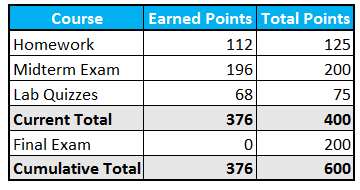
- Penelope has earned 112 points (of 125 points available) on the homework, 196 points (of 200 points bachelor) on the midterm exam, and 68 points (of 75 points available) on the lab quizzes. The grade grade is out of 600 points, with the final exam beingness worth 200 points. The pupil obviously wants an A, and the grading scale is as follows: A: 91%, B: 82%, C: 73%, D: 64%. Tin she go an A in the course? If so, what does she need to get on the Final? If not, what is the highest form she could get?
So far, she has scored 376 points of the 400 points so far awarded. As a grade, 376/400 is a 94% — on track for an A average overall
To get an A overall, she needs 91% of the 600 total form points, or 546 points. That is, she needs an additional 546 (cumulative points) â€" 376 (electric current points) = 170 points. Since the final test is worth 200 points, she needs to score an  85% (170 ÷ 200 = 0.85) on the final test.
Since she has already scored 90% on the homework, 98% on the midterm examination, and 91% on the lab quizzes, she should exist able to get an A in the form. That is, given her by performance, information technology is reasonable to await that she can do sufficiently well on the final exam to get the grade she's hoping for. Even if she has a "brain fart" on the final exam or shows up 30 minutes tardily to it, she shouldn't do worse than a B overall.   Copyright © Elizabeth Stapel 2004-2011 All Rights Reserved
Penelope tin can easily go an A in the course, simply even if she has problem on the final exam, she shouldn't get lower than a B. Hopefully she can keep her head in the books and out of the clouds as the time draws near to crouch down for finals.
The two grading schemes above are pretty like shooting fish in a barrel and like to compute. To find out how yous're doing in any form component'due south subscore (for instance, homework, or quizzes), you just divide the points you've earned by the potential points that could take been awarded so far to get your score or percent.
To find out what y'all demand to score on the final test,
- Add upwardly the points you've earned so far in each grade component
- Subtract this from the number of points necessary for the grade you're wanting to get overall
- Divide the result by the number of points on the concluding exam
This will give you  the percentage grade y'all need on the Terminal and y'all tin can evaluate how reasonable that Final percentage course is by comparing information technology with your subscore percentages.
How practice I calculate my weighted grades?Â
Another basic type of grading scheme is a weighted plan, where the course grade is divided into component parts, each part existence worth some pct of the full grade. The easiest fashion I've found to deal with this is to catechumen the form components into points, and so piece of work from there.
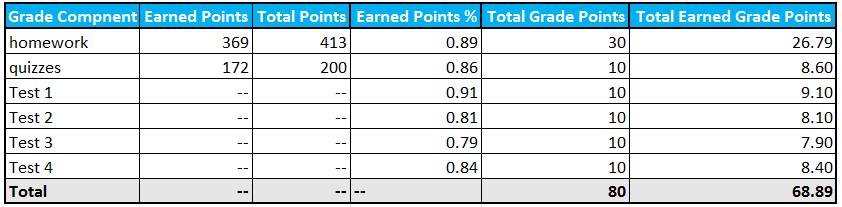
- Returning student Stella has worked hard on her homework (fifty-fifty swallowing her pride and asking her high-school son for assist), and has at least attempted all of the extra credit points available. She has earned 356 points (of the 413 points available) on the homework, earned 172 quiz points (of 200 points available), and got 91%, 81%, 79%, and 84%, respectively, on the four tests. She got thirteen points on the extra credit project, which will be added to her homework score.
The homework is 30% of her grade, the quizzes are 10%, each of the tests is 10% (40% total), and the final exam is twenty%. She is hoping for a B in the course (on a standard ten-point scale). Can she get what she'southward hoping for?
Showtime, I'll add together the extra-credit-project points into her homework grade, so she has 356 (current points earned) + 13 (extra credit points earned) = 369 of the 413 possible homework points.
The next step is to catechumen the subscore percentages into points out of 100. If the homework is worth 30% of her grade, and if I regard her course as being out of 100 points (with "100% in the grade" being "100 grade points"), then homework is worth 30 points of her form. The quizzes are 10 points, each of the tests is x points (for a full of forty points), and the last exam is 20 points.
To find Stella’s subscore percentages for each grade component (homework, quizzes, etc.), I'll split the points that she's earned past the points that are bachelor. To discover out how many grade points she has so far, I'll and then multiply each subscores' grade-points past the percent she earned in that class component. Putting it neatly into a table, I become the following:

Stella wants an A in the course, which ways she has to get a 91%, or 91 course points of 100. She has 68.89 form points earned, so she needs another 22.11 points. But the final test is worth but 20 points, and so she tin can't go an A.
For a B, Stella needs 82 grade points of 100. This ways she needs 82 (total points needed) â€" 68.89 (already earned) = 13.11 more grade points, which means she needs 13.xi (points earned) ÷ xx (final exam signal weight) = 66% on the Last. Since she's done way better than a 66% on every other part of the course, she shouldn't accept whatsoever problem getting a B.
It isn't numerically possible to get an A, but Stella should easily be able to get a B. Her previous good scores and attempts at extra credit might even be enough to assistance sway her instructor to “round up†any discretionary points.
Sometimes the computations may be thrown off a bit by the instructor’s ability to “drop†scores. This gives students a chance to wipe out any major low marks from their record, which may be pulling downward their cumulative average. For instance, I took a chemistry course where we were immune to drop one of our test scores; heck, nosotros didn't even accept to prove up for that test, if we didn't feel similar it (and I didn't). If the scores were averaged together as 100 + 100 + 100 + 0, my average would have been a 75%, misleading considering my previous perfect examination scores. “Dropping†a low score, ways that the 0 score is wiped off the slate and my 100% average remains representative of my success in the form. Computing the grade in such a situation is just like the previous examples, except that each educatee will probably be “throwing out†different scores. If your form has a grading scheme like this, you should definitely keep all of your papers, and then you accept proof of your scores.
- In a certain course, the quizzes are 15% of the grade, the lab score is 25%, the tests are 30%, and the final exam is 30%. Students are allowed to drop the 2 lowest quiz scores and the i everyman test score. This gives students 3 total chances to miss form, study the wrong material, or try taking a examination hungover (for the first and last fourth dimension). Course grades are on a standard ten-point scale: 90% or more is an A, lxxx% or more than is a B, then forth.
Miguel has worked very hard in this class, merely was hospitalized for a while near the start of the semester (we’re going to give him the benefit of the doubt and assume keg stands were non involved), so he'southward glad he can driblet some of those lower scores. His sixteen quiz scores are x, 10, 9, 6, [absent], 9, 8, 10, 7, 10, ten, 9, 9, x, 8, and 9. His iv test scores are 92, 73, 89, and 94. He was a butterfingers in the lab (don't even ask how many crucibles and pipettes he bankrupt), so he earned simply 71% for his lab course.
To get a scholarship side by side near, he really needs an A in this class. Tin can he do it?
Since the quiz component of the grade is the sum of the fourteen highest scores on the 10-point quizzes, the quiz component is out of 140 points. Dropping his 6 and the zippo for when he was absent, Miguel's quiz total is 128.
Since the test component is based on iii tests, I can view this as existence out of 300 points. Dropping the 73, his test total is 275.   Copyright © Elizabeth Stapel 2004-2011 All Rights Reserved
Now I'll brand a tabular array, just like in the previous case:
| Â | component | component | Â component | class | grade |
| quizzes | 128 | 140 | 0.914 | fifteen | 13.71 |
| tests | 275 | 300 | 0.917 | 30 | 27.51 |
| labs | — | — | 0.71 | 25 | 17.75 |
| total | — | — | — | 70 | 58.97 |
So far, Miguel is running a 58.97 (course points earned) ÷ seventy (grade points available) = 84% in the course. To go an A overall, he needs 90% overall, which means he needs to do really well on the Terminal. How well?
To get 90 course-points in the form, he'll demand 90 (points available) â€" 58.97 (points earned) = 31.03 points on the Final. But the Final is worth simply 30 course-points– It is numerically impossible for him to get an A.
However, to get a B, he'll need merely 80 (points available) â€" 58.97 (points earned) = 21.03 points on the final exam, or 21.03 (points needed) ÷ 30 (concluding exam indicate weight) = 70.1%. Since he'south done improve than 70% on everything (outside of the time he was sick), he should accept no problem getting a B.
It is numerically incommunicable for Miguel to go an A, merely he can hands become a B.
For the scholarship, it might assistance if he got a letter from his doctor regarding his disease and a testimonial from his instructor or his lab TA regarding his expert performance once he got out of the hospital, and include these with his application. He shouldn't surrender on the scholarship just because of his disease, because he really did exercise quite well the rest of the time.
Adept luck Miguel. Let’s make everyone’s lives easier and stay out of the hospital next semester, OK?
Different grading schemes will have different details, and there are probably innumerous ways to pattern a syllabus, so the above examples tin't mayhap comprehend every state of affairs. Merely if you tin sympathise the bones methodology of the examples, y'all should be able to figure out what y'all need on the final exam, or any other parts of your class, for nearly any class y'all take.Â
Bottom line: go to class, do your coursework, and report for exams. If in doubt, use the grade calculator to fill up in the blanks and unfurrow your browâ€"you’re too young for wrinkles.  Â
Best of luck, and may the grades be e'er in your favor!
Source: https://gpacalculator.net/grade-guide/
0 Response to "what do i need to get on my test to raise my grade"
Post a Comment